Our response to the Government’s Warm Homes Plan
MECC Trust in Balsall Heath advocate for a shift towards a "resident-first" retrofit model. By prioritising measures like solar panels and PV batteries that provide instant bill reductions.

By Jennie Sandford
21 January 2026
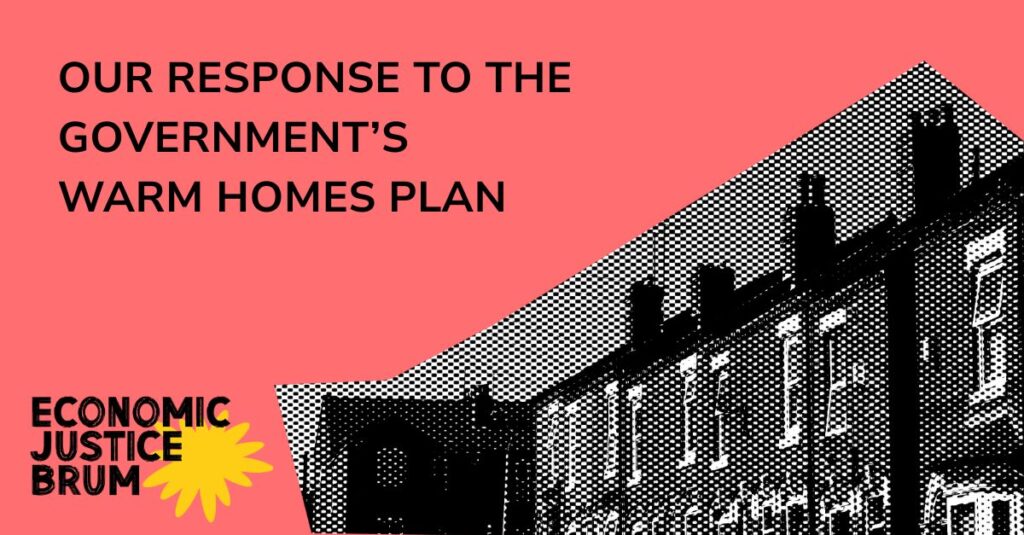
Fuel poverty is one of the key outcomes of economic injustice. For residents in communities like Birmingham, retrofit is not an abstract environmental goal; it is a desperate necessity for survival against skyrocketing energy costs. The government’s £15 billion Warm Homes Plan* must be championed primarily as a frontline humanitarian response to the pernicious crisis of fuel poverty, but there are ways to make it even more impactful.
Funded through Barrow Cadbury Trust‘s Economic Justice Brum movement, MECC Trust in Balsall Heath advocate for a shift away from the rigid “fabric-first” orthodoxy, which has lost credibility due to poor execution and property damage, toward a “resident-first” model. By prioritising measures like solar panels and PV batteries that provide instant bill reductions, the immediate trauma of fuel poverty is addressed. However, any programme lacking rigorous, community-led monitoring risks becoming a wealth transfer from the poor to the rich, leaving vulnerable households with “upgraded” homes they still cannot afford to heat.
The gold standard for this investment is a programme that transforms energy efficiency into a catalyst for local economic stimulus. To truly serve residents, this funding must do more than fix draughty walls; it must repair local economies by mandating that the £15 billion stays within the postcodes being retrofitted. This means creating a pipeline for local jobs, apprenticeships, and training, while supporting local material suppliers rather than distant contractors. By integrating joined-up financing with a customer-centric design that respects cultural needs, the government can move away from top-down models that have historically failed.
For MECC Trust, and Economic Justice Brum, the position is clear: a successful Warm Homes Plan has the potential to deliver a “Triple Win”—immediate relief from fuel poverty, technically sound homes that residents actually trust, and a sustainable local economy that offers a genuine path out of poverty.
Background
Warm Homes Plan
More from EJB
Spread the word
Start talking to your friends and neighbours about what economic justice could mean for Birmingham.


Sign Up
Get email updates from Economic Justice Brum